
Preemptive Exposure Management: Why Intelligence Must Come First

- Preemptive exposure management finds, validates, and neutralizes exploitable exposures before an attacker uses them. Most exposure management still starts from the organization’s own assets.
- Attackers start somewhere else: reconnaissance, stolen credentials, new infrastructure, and the supplier they can reach first.
- A third party is involved in 48 percent of breaches, according to Verizon. A program that stops at the enterprise boundary sees only part of that risk.
- Exposure shows where an attacker could get in. Intelligence shows who is acting on it. A preemptive program needs both.
- The progression runs from vulnerability management to counter-threat operations, where risk is determined at the edge of collection and routed to the teams that act.
Preemptive exposure management is quickly becoming one of cybersecurity’s most important conversations, and for good reason.
AI-enabled attackers are compressing the time between reconnaissance, exploitation, and impact.
Adversaries using AI increased their operations by 89 percent year over year, according to CrowdStrike’s 2026 Global Threat Report. The same report puts the average breakout time for financially motivated (eCrime) intruders, the time they take to move beyond the first compromised host, at 29 minutes in 2025. Verizon’s 2026 Data Breach Investigations Report found that 31 percent of breaches now start with vulnerability exploitation, the first time it has passed stolen credentials as the top way in.
Security teams cannot respond to that acceleration by simply discovering vulnerabilities faster, generating better risk scores, or putting more findings into remediation queues.
The industry needs to act earlier in the attack.
In its March 2026 research on AI and threat intelligence collection, Gartner® writes: “Before any organization can build an effective security posture, it must understand as accurately as possible what its specific threat landscape looks like.”*
*Source: Gartner, AI Revolutionizes Threat Intelligence Collection Architecture, Nahim Fazal, 18 March 2026, ID . Gartner is a trademark of Gartner, Inc. and/or its affiliates
That is a useful starting point. Organization-specific intelligence helps teams focus on the adversary activity aimed at them, and keeps general industry trends from standing in for their own risk.
But at iCOUNTER, we believe there is another question the industry needs to ask:
How preemptive can exposure management really be if it still starts with the exposure?
Preemptive exposure management works best when it starts with adversary intelligence.
What is preemptive exposure management?
Preemptive exposure management is the practice of finding, validating, and neutralizing exploitable exposures before an attacker uses them. It builds on Continuous Threat Exposure Management (CTEM), the five-stage program that decides which exposures matter, and pushes toward continuous validation, automated remediation, and machine-speed mitigation.
Cyber risk management can be viewed as a progression, and each stage asks a different question:
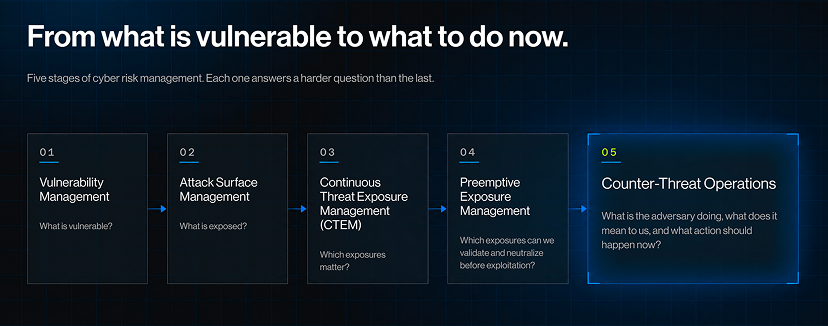
The difference is important. Finding a vulnerability is one thing. Knowing whether it creates a meaningful risk, and being able to do something about it before an attacker gets there, is another.
Modern exposure management platforms increasingly use automation, attack-path analysis, validation, simulation, and agentic AI to help make that possible. The direction is right.
But most exposure management still begins by looking inside-out. It starts with your assets, identities, vulnerabilities, configurations, attack paths, and controls. The adversary starts somewhere else.
The attacker does not start with your exposure management platform
Attackers do not begin their operations by asking which vulnerabilities appear at the top of your exposure management dashboard. Their work starts earlier, outside your walls:
- They conduct reconnaissance on organizations, executives, identities, vendors, suppliers, infrastructure, SaaS providers, and business relationships.
- They acquire credentials and test access.
- They register infrastructure.
- They develop fraud campaigns.
- They exploit weaknesses across interconnected ecosystems.
And increasingly, the way in runs through a third party. The same Verizon report found a third party involved in 48 percent of breaches, a 60 percent rise in a year.
That activity generates intelligence long before it necessarily becomes an exposure finding inside the enterprise. This is where an outside-in view matters.
Finding an exploitable condition and fixing it faster is valuable. Intelligence about adversary activity adds something exposure data alone cannot: insight into what threat actors are actually doing.
Exposure is only half of the risk equation
Most exposure management programs are designed around conditions:
- A cloud service is misconfigured.
- An identity has excessive privileges.
- A server contains an exploitable vulnerability.
- A vendor has a weak security posture.
- An attack path exists between an initial access point and a critical asset.
These are important conditions to understand. But a condition is not the same as a threat. A Common Vulnerability Scoring System (CVSS) base score describes how severe a flaw is. It says nothing about whether anyone is preparing to use that flaw against you.
Consider two vendors with similar external exposure. One has a vulnerable internet-facing service. The other has the same vulnerable service. Threat actors are also discussing the company, compromised credentials associated with its employees are circulating, adversary infrastructure is interacting with its domains, and targeting activity suggests attackers are preparing to exploit the relationship.
Looking only at exposure, the two vendors look similar. They should not carry the same operational priority. That is where intelligence changes the picture.
Exposure management helps identify what could happen. Intelligence adds information about what adversaries are actually doing.
As security moves toward preemptive cybersecurity, that distinction matters.
Preemptive cybersecurity requires an outside-in view
Preemptive cybersecurity cannot rely only on what defenders see inside their own environments. It also needs an outside-in view of adversary behavior.
Preemptive cybersecurity stops attacks while they are still being prepared, before detection and response come into play. In a press release dated September 18, 2025, Gartner said preemptive cybersecurity “includes capabilities such as predictive threat intelligence, advanced deception and automated moving target defense.”† The same release states: “By 2030, preemptive cybersecurity solutions will account for 50% of IT security spending, up from less than 5% in 2024 …”†
†Source: Gartner Press Release, “Gartner Says That in the Age of GenAI, Preemptive Capabilities, Not Detection and Response, Are the Future of Cybersecurity,” September 18, 2025.
An outside-in view brings together five elements:
Exposure tells us where an attacker could have an opportunity. Intelligence helps determine where there is actual activity behind that opportunity. Together, they give defenders a better basis for deciding what needs attention now.
Risk determination at the edge of collection
Risk determination at the edge of collection is iCOUNTER’s term for deciding whether a signal matters as close as possible to the point where the intelligence is collected.
Traditional cyber threat intelligence can create another version of the problem exposure management is trying to solve. The usual pipeline runs in five steps:
- Collect everything.
- Send it to a platform.
- Generate alerts.
- Ask analysts to determine what matters.
- Eventually, route something into an operational workflow.
As attackers get faster, there is less time for all of those steps.
At the edge of collection, the enterprise’s unique risk profile directs what is collected, and analysts no longer have to find what matters afterward. Signals are correlated against live context, including vendors, suppliers, identities, assets, business relationships, and ecosystem dependencies.
The objective is relevant intelligence that can immediately drive action. That is the foundation of counter-threat operations.
Preemptive security must extend beyond the enterprise
The enterprise perimeter is no longer the enterprise attack surface. Modern organizations depend on a long list of outside entities: vendors, SaaS providers, cloud providers, managed service providers (MSPs), contractors, suppliers, payment processors, technology partners, and fourth parties. The World Economic Forum’s Global Cybersecurity Outlook 2026 found that 65 percent of large companies name third-party and supply chain vulnerabilities as their greatest challenge, up from 54 percent a year earlier.
Traditional third-party risk management (TPRM) programs are built primarily around governance, due diligence, assessments, questionnaires, and periodic monitoring. Those functions remain necessary. But they do not provide the same information as live threat intelligence.
A questionnaire cannot tell you that an adversary began targeting a supplier this morning. A security rating cannot tell you that compromised credentials tied to a critical vendor are being operationalized in an active campaign. And a point-in-time assessment cannot determine whether an attacker is pre-positioning against a business relationship right now.
That leaves an important gap.
Preemptive cybersecurity has to look beyond internal exposure and consider active threat activity across the broader ecosystem.
iCOUNTER’s Counter Threat Operating System, CTOS™, is designed around that model. CTOS maps the enterprise ecosystem, collects threat signals associated with those relationships, determines which signals represent material risk, and routes validated Compromise Intelligence to the teams that act on it: the security operations center (SOC), TPRM, vendor escalation, and governance, risk, and compliance (GRC). Compromise Intelligence is iCOUNTER’s term for adversary activity detected against the vendors, suppliers, and partners in an organization’s ecosystem.
This does not make exposure management or traditional TPRM less important. It adds live adversary context to help determine which risks require attention now.
See what threat intelligence has already found about the third parties you work with.
Where counter-threat operations fits
Counter-threat operations adds another critical layer to the four stages before it: live adversary context that helps determine which risks require action before they result in business impact. The goal is to connect intelligence, enterprise context, risk determination, and action, alongside the security systems already in place.
The five stages in the table above are not mutually exclusive. Organizations still need vulnerability management, attack surface management, CTEM, and TPRM. Preemptive exposure management makes those investments more operational.
From systems of record to systems of action
The shift from systems of record to systems of action puts intelligence, enterprise context, risk determination, and action into one process. For years, cybersecurity has invested heavily in systems designed to record conditions:
Exposure management has helped connect those systems and prioritize their findings. Preemptive exposure management pushes the industry closer to action. But a better record of risk is not the end goal.
Organizations need to be able to determine: this threat matters to this organization right now, because of this relationship, and this action should happen next.
In a system of action, a risk no longer waits to be recorded before anyone decides what to do with it.
Where do the earliest attack signals show up?
The earliest opportunity to stop an attack often comes before the exposure enters the remediation process. It shows up in:
- Adversary reconnaissance
- Compromised credentials
- Domain activity
- Criminal marketplaces
- Infrastructure preparation
- Targeting against a supplier
- Patterns of activity across organizations that share a common dependency
These signals do not replace exposure management. They give defenders another piece of the picture, and one that can arrive earlier.
Preemptive exposure management represents meaningful progress. The industry should move from passive exposure discovery toward continuous validation, automated remediation, and machine-speed mitigation.
One way to measure progress is time: the hours between the first adversary signal against you or a supplier and the first action your team takes.
The question is no longer simply “What are we exposed to?” It becomes “What is targeting us, why does it matter, and what can we do about it before impact?”
That is the opportunity created by connecting exposure management with adversary intelligence. It takes preemptive cybersecurity beyond knowing what an attacker could exploit and adds an understanding of what adversaries are actually doing.
And that is where exposure management becomes counter-threat operations.
%201.avif)




.avif)