Third-Party Risk Gets Operational: Takeaways from Philadelphia's Leadership Exchange
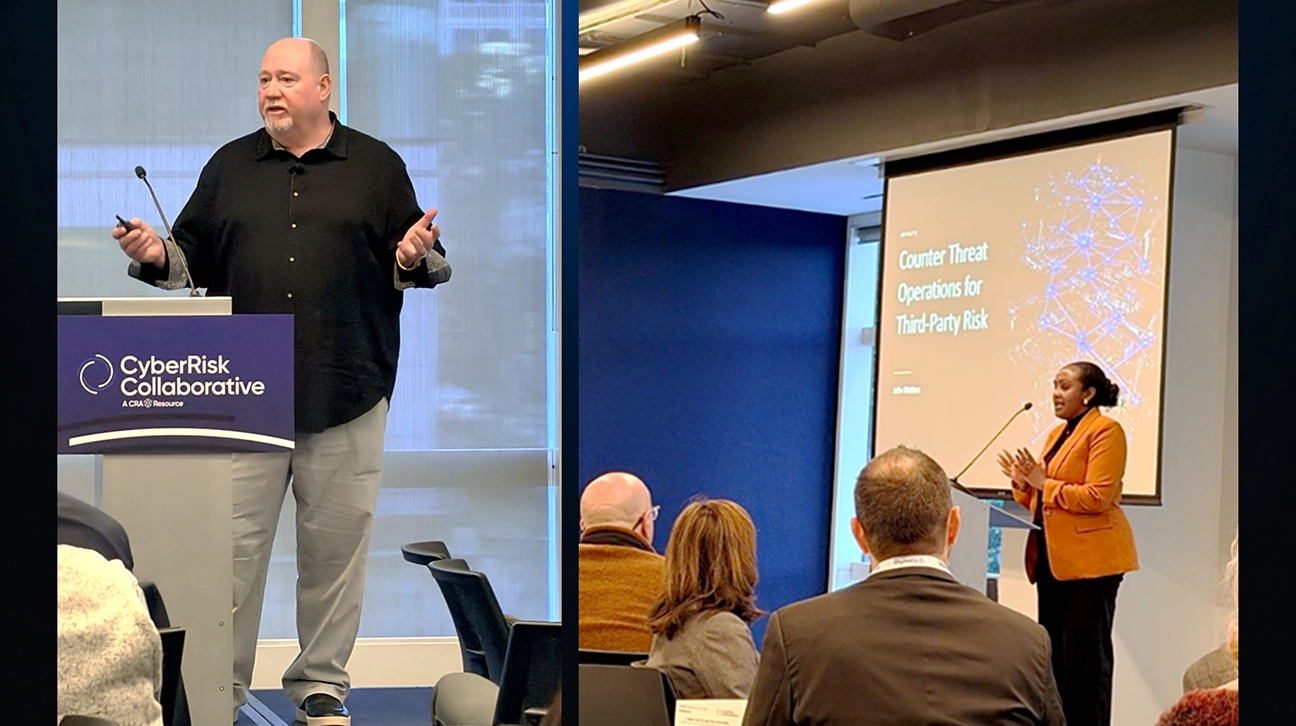
At CyberRisk Collaborative's Philadelphia Leadership Exchange, John Watters' keynote on third-party risk drew the strongest reaction, raising eyebrows and prompting questions from attendees that continued the conversation as many approached the iCOUNTER team afterward to dig deeper.
How does iCOUNTER identify third parties? What if an organization doesn't know its own dependencies? What does autonomous remediation actually look like? Together, these questions expose where security leaders need help most: understanding their ecosystem and acting on threats across it.
The risk stays with your organization
John's keynote brought a familiar business reality into sharper focus: outsourcing a service leaves the organization accountable for the consequences if that service is compromised.
A third party runs its own security program. Your organization still depends on that company to operate safely. That creates a gap between the risk you own and the controls you can directly manage.
Security assessments help organizations evaluate those relationships. They establish expectations and support decisions about whether a third party's security posture is acceptable. But an assessment can't tell you whether an attacker is selling access to that company today.
That requires intelligence about live threat activity, connected to the specific relationships that matter to your business. It also requires a way to get the affected third party engaged before the threat becomes your disruption. The audience's response, including the conversations that continued afterward, showed how strongly that challenge resonated.
"What if we don't know who our third parties are?"
Some of the most revealing questions concerned the starting point. Many organizations face a foundational challenge: their dependencies extend well beyond the relationships captured in a central list. Different business units may rely on different providers, and the people managing those relationships may sit far from the security team.
For organizations facing that uncertainty, the first step is to establish which external relationships support their most important operations. Procurement records and conversations with business owners can help identify an initial set of priority partners.
iCOUNTER's documented onboarding process starts with a simple CSV of those priority ecosystem partners. That provides the context for determining which detected threats are relevant to the customer. Understanding which companies your business depends on is essential for determining which threats could actually affect your operations—a foundation every third-party risk program needs.
An incomplete inventory should prompt work on those gaps while the organization begins addressing threats against the critical relationships it already knows.
Autonomous remediation drew repeated interest
Autonomous remediation surfaced repeatedly in the discussion. Its appeal is straightforward: detecting a threat creates another obligation for a security team that already has plenty to do.
Someone has to validate the finding, determine its relevance, reach the right person at the affected company, and follow the response through to completion. Across a large ecosystem, that work can become a substantial operational burden.
The value of automation depends on how much of that process it helps complete. A faster notification still leaves work waiting for someone.
iCOUNTER's Counter Threat Operating System, CTOS, connects intelligence collection with customer-specific risk determination and managed remediation. The service validates relevant threats, engages affected third parties with prescriptive action, and tracks remediation to completion with evidence.
That gives the conversation about autonomy a concrete focus: how quickly can a validated threat reach someone who can fix it, and how do we know the fix happened? Clear accountability remains essential as more of the process becomes automated. Security leaders need to understand who acts, what action they take, and how the outcome is verified.
Why this resonated: Healthcare's operational perspective
Healthcare attendees made up a substantial part of the audience, and their presence gave the discussion sharp, practical meaning. For a healthcare organization, evaluating a provider relationship means considering how a disruption could affect the services that patients and staff rely on.
That makes operational context essential. A third party's importance depends on what it supports, what access it holds, and what happens if it becomes unavailable or compromised. It also makes the time between detection and remediation consequential. Identifying a threat early creates an opportunity to act, provided the intelligence reaches the people who can address it quickly enough to matter.
The strong healthcare turnout reinforced the relevance of an approach that connects ecosystem threats to operational priorities. The same logic applies across sectors: where downtime has real consequences, the speed and clarity of your third-party threat response becomes a competitive and operational asset.
What happens after detection matters
John's keynote resonated precisely because it reached the work security leaders actually need to get done. His presentation sparked genuine interest: attendees wanted to understand their dependencies, wanted clarity on autonomous remediation, and continued asking questions because his framing of third-party risk accountability made the challenge impossible to ignore.
Progress means knowing which critical partners face active threats and having a process to get those threats addressed. It means measuring the time from detection to action and keeping accountability clear across organizational boundaries.
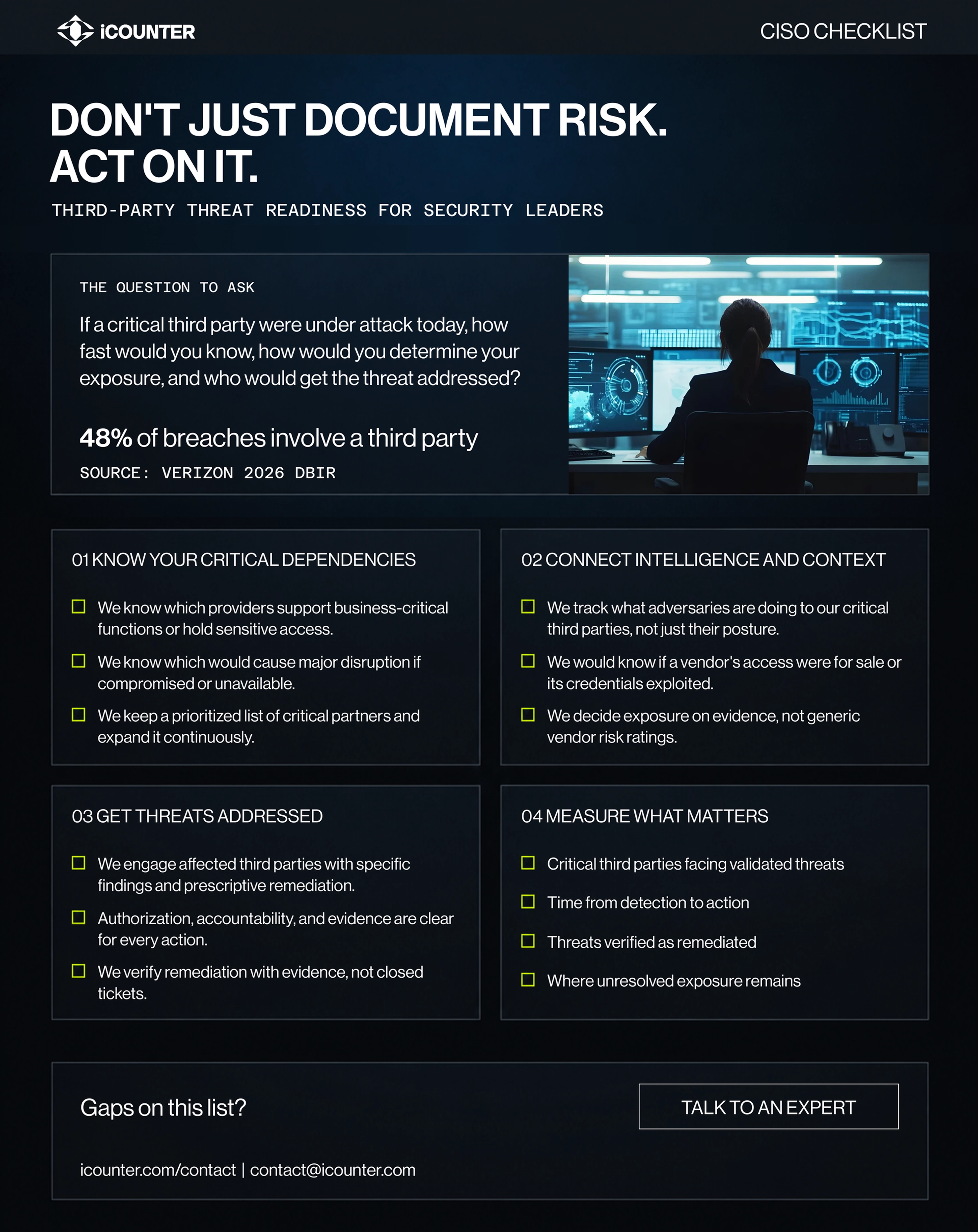
Use the checklist below to assess how prepared your organization is to act on threats across its third-party ecosystem.
Thank you to CyberRisk Collaborative and everyone who joined us in Philadelphia for an engaged discussion.
To explore what live threat activity means for your priority third parties, request an Ecosystem Threat Briefing with iCOUNTER.
REQUEST ECOSYSTEM THREAT BRIEFING
Do we know our actual ecosystem?
Do we understand access, not just vendor names?
Can we identify concentration risk?
Are we detecting change between assessments?
Can we turn intelligence into action?
RELATED CONTENT